วิชาการ Ignition timing for engines converted to run on LPG จะใช้ LPG ให้ได้ใกล้เคียงน้ำมัน

เครื่องมือในการใช้งาน website =>> สมัครสมาชิก | Login | Logout | เปลี่ยนไอคอนประจำตัว | เกี่ยวกับเรา | ติดต่อโฆษณา         View Stats by Truehits.Net


จาก mong_bky
ศุกร์ที่ , 28/7/2549
เวลา : 09:29
 IP:

203.146.104.35
อ่านแล้ว = 2862 ครั้ง

แจ้งตรวจสอบกระทู้
 แจ้งลบ
ส่งหาเพื่อน ส่งหาเพื่อน


เจ้าของกระทู้เห็นเท่านั้น
edit แก้ไขข้อความ
 เปลี่ยนรูป
       ความรู้ที่เพื่อนผมซึ่งเป็น วิศวกร Electrinics สรรหาจาก web มาให้
Ignition timing for engines converted to run on LPG
It is important to remember that the burning rate of LPG differs from that of petrol. At low RPM the burning rate is slower and more advance is needed. At high speeds the burning rate is faster, consequently less advance is needed.
When an engine is converted to run on LPG as a single fuel engine the ignition timing should be revised to give more ignition advance than the petrol engine at low speeds, and less than the petrol engine at higher speeds. This means that conventional distributors must have adjustments made to the mechanical advance mechanism to reduce the rate that advance increases with speed. Merely altering the static timing is not correct.
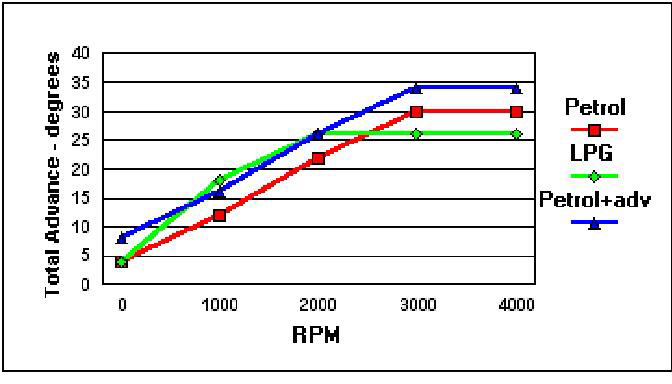
In the case of a dual fuel conversion the matter is complicated because the ignition timing needed for optimum performance on petrol will give too much advance at high speeds when LPG is used. The difference could be as much as 10 degrees, see graph below. This graph shows typical timing for a petrol engine tuned for petrol only, a correctly calibrated LPG setting and compares these with incorrect timing for LPG achieved when the distributor has been advanced with no adjustment for rate, "Petrol+adv".
These ignition advance curves are notional only and not specific to any engine type. They include static advance and mechanical advance (which is speed dependent) but do not include any part throttle advance as this is manifold vacuum dependent.
GRAPH

These graphs show the following;
• An engine tuned for optimum performance on petrol and running on LPG will have too little advance at low RPM and too much at high RPM. It could therefore encounter detonation at higher RPM.
• An engine tuned for optimum performance on petrol and running on LPG with the distributor advanced but not recalibrated with a different rate will have excessive advance at high RPM, and a higher probability of encountering detonation.
• An engine tuned for optimum performance on LPG and running on petrol will have excessive advance at low RPM and therefore a possible detonation problem.
• Incorrect ignition timing on any engine will lead to problems. Detonation is not always audible. The nature of the problems encountered will vary with the engine type, the octane rating of the fuel (petrol or LPG), engine speed, and in the case of LPG the installation and type of conversion and the source of the LPG.


 แสดงความคิดเห็นย่อย แสดงความคิดเห็นย่อย


 จาก Ignition Timing ต่อ2
 ศุกร์, 28/7/2549
 เวลา :
09:31
 IP:
203.146.104.35

เจ้าของคำตอบเห็นเท่านั้น
edit แก้ไขคำตอบ
 เปลี่ยนรูป


แก้ไข / ลบคำตอบ

 คำตอบที่ 1
       Here is a list of some typical and some less common effects observed on dual fuel engines operating in Australia:
• Piston land or crown erosion
• Ring land breakage
• Groove wear
• Skirt scuffing (usually on the thrust side only) or breakage
• Top ring scuffing or breakage or molybdenum flaking out
• Spalling of the chromium on oil ring rails

Unfortunately it is not possible to optimise the ignition advance rates for petrol and LPG with the one setting on a distributor so a compromise setting will usually be obtained. From a performance point of view this may represent little problem since the engine is most likely to run on petrol only occasionally, i.e. when the gas tank is empty. Later engines with engine management systems and the more sophisticated LPG conversions can have the advance rate and initial spark timing settings optimised for both fuels.
Ignition Switching Devices
The best way to be sure that the ignition is optimised for both fuels is to install an ignition switching device, known also as "Dual Curves". These units are wired into the ignition system and switch automatically to the LPG or petrol setting when the fuel switch is activated. They will give more initial advance than the petrol setting when the engine is running on LPG, and as speed increases they will give less advance than the petrol setting. Although these are usually pre-calibrated for a range of applications (i.e. not necessarily calibrated for a particular engine) they will give a much better approximation to the ignition requirements for engines being converted than the incorrect practice of merely altering the static timing.
Small Engines In Commercial Applications
It can be seen from the graph "LPG" that there is less advance needed at higher operating speeds for any engine running on LPG. For larger more powerful vehicles operating in city areas the engine is seldom operating at maximum power so is possibly going to be less liable to damage as a result of incorrect ignition calibration.
However smaller engines fitted to delivery vans operating in city areas will usually be operating at higher loads and frequently at maximum throttle. These applications are typically Mazda FE and MA engines in light commercial applications and they work much harder due to the weight of the vehicle and even the way in which these vehicles are driven. If they are merely given some additional static advance (as often seems to be the case) the error is exaggerated at higher speeds because there was already too much advance at high speed when the ignition was set as standard. Referring to the graph again, note the error that would occur if the LPG engine is operated on the petrol calibration at high speed. That is bad enough, but now if the static timing is advanced as per curve "Petrol+Adv" (i.e. by merely advancing the distributor) then the error is doubled!
For this reason it is even more critical that any dual fuel LPG conversion in such an application includes a dual curve ignition switching device. (There is one made by AEB and available from major LPG conversion companies).
Nevertheless it is the responsibility of the customer to ensure that the engine is not damaged by continued operation with ignition settings not optimised for the fuel being used.


 จาก Ignition Timing ต่อ3
 ศุกร์, 28/7/2549
 เวลา :
09:33
 IP:
202.44.210.31

เจ้าของคำตอบเห็นเท่านั้น
edit แก้ไขคำตอบ
 เปลี่ยนรูป


แก้ไข / ลบคำตอบ

 คำตอบที่ 2
       LPG Fuels
LPG fuels vary far more from state to state, area to area, and from time to time than petrol. The variation is often due to the proportion of propylene in the fuel which is based mainly on propane and butane. Propylene depresses the octane number. The octane value of LPG is usually regarded to be 100 to 105 RON. However it is understood that octane levels in some cities are often as low as 96 which is the same as super grade leaded petrol. Consequently there can be abnormal combustion problems (i.e. detonation) in LPG fuelled engines where the compression ratio has been raised to take advantage of the supposedly higher octane number of LPG. Also there could be problems in these engines where the compression ratio is standard, (or slightly increased as a result of reconditioning) where the ignition has been incorrectly advanced at static only. Remember that for every degree of mechanical advance you add the initial static advance to it. In other words if the distributor mechanical advance is providing 4 degrees at 600 RPM and the static timing is 6 degrees BTDC the total advance that the engine sees at 1,200 RPM is 14 degrees. Also if the compression ratio of an engine is raised for any reason the amount of ignition advance that is needed to achieve best performance usually decreases and failure to take account of this can lead to detonation occurring.


Summary and Recommendations
• Ignition requirements for LPG are not the same as for petrol operation
• The octane rating of LPG (i.e. its knock resistance) cannot be assumed to be the same in all areas of Australia and at all times.
• Advancing the static ignition setting without also modifying the advance curve to reduce the rate of advance is incorrect and will promote abnormal combustion.
• Detonation problems are likely to be encountered if the ignition is not optimised for the fuel being used at the time.
• Switching devices which automatically alter the ignition advance and static settings are available and their use is strongly recommended.
• Compression ratio should not be increased for LPG unless the octane number of the fuel to be used is known to be 100 or greater, and maintained at that level.
• Small engines doing a big job (i.e. in light commercial applications) are more prone to detonation induced problems due to their duty cycle being mostly at high loads and speeds.
• It is not the responsibility of a product supplier, nor the engine reconditioner, to ensure that an engine is properly tuned since neither can be fully aware of the operating circumstances and the degree of modification which has taken place since the engine was originally designed (to run on petrol) and manufactured.
• Ultimately it is the responsibility of the owner of the vehicle to ensure that the appropriate measures have been taken to avoid abnormal combustion in any vehicle converted to LPG.


Author: Kathy Dimovski 11/11/98 14:16:00
Last changed by: Joe Thomlinson 19/11/1998 09:31:08

© Automotive Components Limited
Reproduction in whole or in part is prohibited without written approval.


 จาก Ateam
 ศุกร์, 28/7/2549
 เวลา :
10:09
 IP:
203.158.212.19


แก้ไข / ลบคำตอบ

 คำตอบที่ 3
       1 ปรับStatic Advance ให้เพิ่มขึ้น และ
2 เพิ่มความแข็งของสปริง ไดอะแฟรมแรงดูด
จะทำให้ใกล้เคียงกับกราฟสีเขียวมากขึ้น
เอกสารเพิ่มเติมหาข้อมูลได้จากหนังสือ เครื่องยนต์สันดาปภายใน Internal Combustion Engines
ในส่วนเชื้อเพลิงอื่นๆ วิชานี้เป็นวิชาชีพเฉพาะ
ในสาขาวิศวกรรมเครื่องกล กำหนดโดยโดยสภาวิศวกร


 จาก YJ:-D
 ศุกร์, 28/7/2549
 เวลา :
10:11
 IP:
192.55.18.36


แก้ไข / ลบคำตอบ

 คำตอบที่ 4
       Very informative article, I'll apply this to my gas system calibration.
Any update will keep you all posted.


 จาก BallyGTR
 ศุกร์, 28/7/2549
 เวลา :
12:37
 IP:
202.28.24.130


แก้ไข / ลบคำตอบ

 คำตอบที่ 5
       โห...ใครอ่านแล้วสรุปให้ฟังหน่อยสิครับ
อย่าลืมเรื่องช่วงเวลาในการเผาไหม้ของLPG ด้วยนะครับ


 จาก noi101 TAC#31
 ศุกร์, 28/7/2549
 เวลา :
12:49
 IP:
124.120.47.52


แก้ไข / ลบคำตอบ

 คำตอบที่ 6
       ตกอังกฤษครับใครรู้แปลที


คำถามนี้มีทั้งหมด 6 คำตอบ ขณะนี้คุณอยู่ที่หน้า 1 จาก >>> 1  คลิ๊กเพื่อดูหน้าถัดไป


Last update : 3/Nov/2013


หน้าแรก || สมัครสมาชิก || LOGIN || LOGOUT || เปลี่ยนไอคอนส่วนตัว || เกี่ยวกับลิขสิทธิ์บทความภาพถ่าย || ข้อตกลงและเงื่อนไขในการใช้เว็บ || เกี่ยวกับเรา || ติดต่อโฆษณา
แจ้งปัญหาการใช้งาน GasThai.Com หรือขอความรู้และขอคำปรึกษารถยนต์ติดแก๊ส LPG/NGV ติดต่อ :::>>>Email::: webmaster@GasThai.Com   หรือ   ติดต่อเรา(Contact Us)
Copy Right © Gasthai.com December 2005   Counter View Stats Truehits.Net  (Online  คน)